For Planners
Why the Best Event Planners Are Adding a Magician to Their Vendor List

Not sure what fits your event? Take the 35-second quiz
Why top event planners are adding close-up magicians to their go-to vendor lists, how magic solves the early-event energy gap, requires zero logistics, and generates client referrals.
If you're an event planner, you have your go-to vendors. The florist you trust. The photographer who always delivers. The caterer you've worked with a dozen times. The DJ or band you recommend without thinking twice.
But here's something I've been noticing over the past few years: the planners who consistently get the best client feedback are the ones who've added a close-up magician to that list. Not as a gimmick. Not as a novelty. As a reliable tool for solving a very specific problem that every event has.
I want to explain why, because this shift is happening faster than most people in the industry realize.
The problem every planner already knows about
You've planned the event down to the minute. The venue is beautiful, the food is perfect, the flowers are exactly what the client wanted. And then cocktail hour starts, and you watch 150 people stand around holding drinks, making polite conversation, looking at their phones.
You know this moment. You've seen it at weddings, corporate dinners, galas, and holiday parties. Everything looks right, but the energy isn't there yet. People haven't warmed up. The event doesn't feel alive.
Traditionally, entertainment addresses this by adding something to listen to or look at. A band, a DJ, a photo booth. These are passive solutions. They fill the space, but they don't change the dynamic between the people in the room. The conversation stays shallow. The energy stays low until enough time passes and enough drinks are consumed that people loosen up on their own.
Planners accept this as normal because it's how events have always worked. But it doesn't have to be.
What a close-up magician actually does at an event
I'm not talking about a guy on stage pulling rabbits out of hats. That's a different thing entirely.
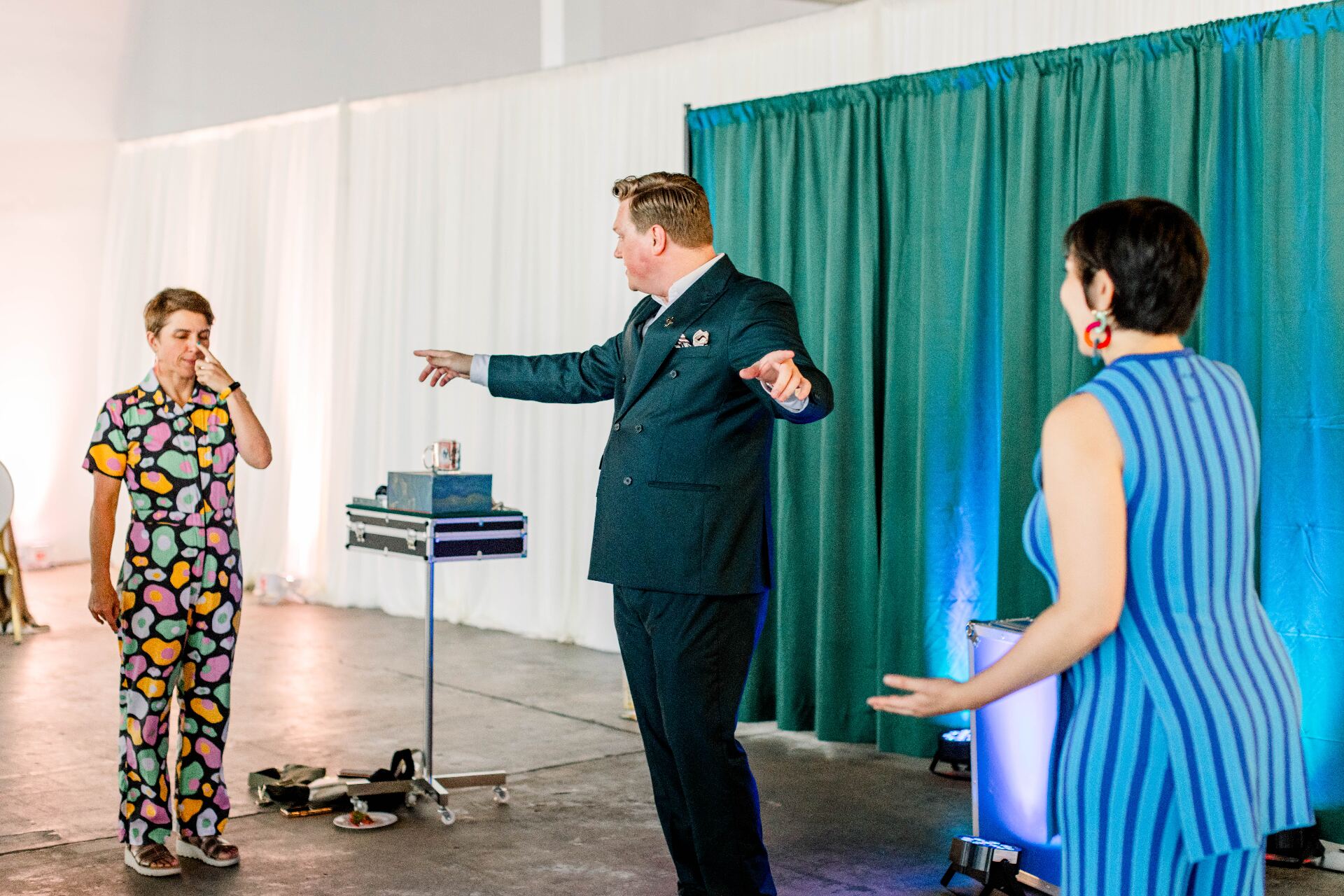
A close-up magician works the room during cocktail hour and after the meal, performing intimate magic for small groups of three to eight people. No stage, no microphone, no "ladies and gentlemen" announcement. Just a person walking up to a group and doing something impossible right in front of them.

What happens next is the part that matters to you as a planner. The group reacts. They laugh, they gasp, they grab the arm of the person next to them. They turn to someone at the next table and say "you have to see this." The magician moves on to the next group, and the first group keeps talking about what they just saw.
Repeat this 30 or 40 times during a cocktail hour, and the room feels completely different than it would have without it. People are engaged. They're talking to people they wouldn't have otherwise. The energy is up, and it happened organically, not because someone turned the music louder.
As a planner, this is gold. Your client notices the room feels great. Their guests are having fun. The event photos look better because people are animated instead of standing stiffly with drinks. The feedback the client hears after the event is "that was amazing" instead of "it was nice."
Why planners specifically are adding this to their lineup
I've talked to a lot of planners about why they started recommending a magician, and the reasons come down to three things.
First, it solves the early-event energy gap that nothing else solves reliably. Every planner knows that the first 60 to 90 minutes sets the tone for the whole evening. If the room is dead during cocktail hour, it's harder to get the energy up later. Close-up magic during that window changes the trajectory of the evening in a way that a DJ or a band simply doesn't.
Second, it's logistically easy. This matters a lot when you're managing a dozen vendors. A close-up magician doesn't need a stage, a sound system, power, a green room, a load-in window, or coordination with your AV team. I show up, I check in with the planner, and I'm ready. When the event schedule shifts, and it always shifts, I adapt without asking anyone for anything. One less vendor to worry about.
Third, it generates the kind of client feedback that leads to referrals. When a client's guests are talking about the entertainment for weeks afterward, that client attributes the success to the
Third, it generates the kind of client feedback that leads to referrals. When a client's guests are talking about the entertainment for weeks afterward, that client attributes the success to the planner who recommended it. I've had planners tell me they get new business directly because a past client mentioned the magician at their event. That word-of-mouth is hard to generate with a DJ or a photo booth, because those are expected. Magic is unexpected, and the unexpected is what people talk about.
The shift in what clients want
Here's something that's changed in the past five years. Clients used to ask for specific entertainment: "We want a band" or "We need a DJ." Now, more often, they're asking for outcomes: "We want people to have a great time" or "We want the energy to be high" or "We want something people will remember."
When a client describes what they want in terms of outcomes instead of formats, you're free to recommend whatever actually delivers that outcome. And what I've seen is that planners who've worked with a good close-up magician once start recommending it as a default because it consistently delivers the outcome clients are asking for.
Insider Access
Enjoying this? There's more where it came from.
Get behind-the-scenes stories, event planning insights, and first access to upcoming shows. No spam, just magic.
No spam. Unsubscribe anytime.
This isn't about replacing DJs or bands. Those serve different purposes. It's about recognizing that the gap in most events isn't audio. It's interaction. A magician fills that gap.
Who's already doing this
I've worked with planners who handle events for Netflix, Disney, Morgan Stanley, Rolls Royce, and dozens of other companies. I'm a member of the Magic Castle in Hollywood, which is relevant because it means I've been vetted by the institution that sets the standard for close-up magic performance. But the clients that matter most to me aren't the famous names. They're the planners who book me two, three, four times a year because they've seen firsthand what it does for their events.
The repeat bookings tell the real story. A planner doesn't keep hiring the same vendor unless that vendor makes their job easier and their events better.
What to look for if you're adding a magician to your vendor list
Not all magicians are right for corporate or high-end events. Here's what to vet:
Watch their video. You want footage from actual events, not a stage show. Look for a performer who's engaging small groups, moving through a room, and getting genuine reactions.
Ask about insurance. If they can't provide a COI quickly, they're not working at a professional level.
Ask about their setup needs. If they need a stage, a sound system, or dedicated lighting for what should be a roaming cocktail performance, they're a stage performer trying to do close-up work.
Ask about timing flexibility. Your event schedule will change. The magician needs to be able to adjust without creating a problem for you.
Call their references, specifically planner references. What was the magician like to work with? Did they show up on time? Were they professional? Did they coordinate with the team? The answers to these questions matter more than how impressive their tricks are.
The vendor list argument
Your vendor list is your reputation. Every person on it reflects your judgment. When you recommend someone and they deliver, your stock goes up. When you recommend someone and they don't, it comes back to you.
Adding a close-up magician to your list is only worth it if you've found someone who operates at the level your events require. Someone who understands the planner's world, who shows up prepared, who reads the room, and who consistently generates the kind of feedback that makes your client glad they hired you.
That's what I try to be for the planners I work with. If you want to see whether this makes sense for your events, I've put together a page specifically for event professionals. You can see what working with me looks like, or you can take the quick quiz to figure out what format fits your next event. Or just reach out directly.
Ready to Elevate Your Next Event?
Tell us about your event and we'll usually confirm availability within a few hours.
35-Second Quiz
Not Sure What You Need? Take the Quiz
Take our quick quiz and discover your Magic Guest Persona, plus get a personalized, downloadable card to share.
No commitment, just a fun reveal and a tailored recommendation.
Take the QuizWhere We Perform
Luxury Event Entertainment Nationwide
Continue Reading
For Planners · 4 min read
This Isn't Your Kid's Birthday Party: What Modern Magic Actually Looks Like
The word 'magician' carries baggage. Here's what professional magic actually looks like at the highest level, and why it has nothing in common with what you're imagining.
For Planners · 5 min read
The Entertainment Gap Most Planners Don't Know They Have
You've perfected the venue, the catering, the florals, and the timeline. But there's a gap in your events you might not have noticed, and it's costing your clients memorable moments.
For Planners · 5 min read
What Happens When You Surprise Your Clients with Entertainment They Didn't Know They Wanted
Your clients hire you because you know things they don't. Here's how recommending entertainment they never thought to ask for becomes your biggest competitive advantage.
© 2026 White Rabbit Los Angeles. All rights reserved. No part of this publication may be reproduced, distributed, or transmitted in any form or by any means without the prior written permission of the publisher. All trademarks, service marks, and trade names referenced herein are the property of their respective owners.