Corporate Events
Fundraiser and Gala Entertainment: How to Energize Your Donors

Not sure what fits your event? Take the 35-second quiz
How the right entertainment during cocktail hour and dinner at your gala can increase donations, a guide for nonprofit event planners on warming up the room before the ask.
Every nonprofit gala has the same structure. Cocktail hour, dinner, a program with speeches and a video, the live auction or paddle raise, maybe some dancing afterward. The organizations that raise the most money aren't the ones with the best auction items or the most emotional video. They're the ones that get the room's energy right before the ask.
I've performed at galas and fundraisers for years, and I've watched the same pattern play out over and over. The events where donors give generously are the ones where people are loose, connected, and having a good time before anyone asks them for money. The events where the fundraising falls flat are the ones where guests spent cocktail hour checking their phones and making small talk with their spouse, then sat through dinner without connecting to anyone new.
The entertainment you choose during the first 90 minutes of your gala determines how the rest of the evening goes.
The cocktail hour problem at galas
Gala cocktail hours are awkward. I know that's a blunt way to put it, but it's true. Your guests are wearing formal clothes, standing in a room with people they may not know well, and trying to figure out who to talk to. Some of them came because they care about the cause. Some came because their company bought a table. Some came because their friend is on the board and guilted them into it.
None of these motivations create natural conversation. So you get clusters of people who arrived together, talking to each other, while the rest of the room mills around waiting for dinner.
This matters because a room full of disconnected people doesn't give money the same way. When the paddle raise happens, people are influenced by the energy around them. If the table next to you is excited and engaged, you raise your paddle higher. If everyone at your table has been bored for two hours, you do the minimum and leave early.
What most galas do for entertainment
The standard playbook is a band or a DJ. Sometimes both. Music during cocktails, a band set during dinner or after the program. It's fine. Nobody complains about it. But it also doesn't change the room's energy in a meaningful way.
Some galas bring in a celebrity or a keynote speaker. That's great if you can afford it and if the celebrity actually moves the needle. But a celebrity appearance is a moment. It happens, people take photos, and then the energy goes back to whatever it was before.
Photo booths are popular at galas because they give sponsors a branding opportunity and give guests something to do. Same limitation as everywhere else: 30 seconds of activity, then the person moves on. It doesn't create the kind of sustained engagement that changes how the room feels.
The entertainment that actually changes the trajectory of a gala evening is the kind that creates real interaction between people who don't know each other. That's the part most event committees miss when they're planning.
Why close-up magic works before the ask
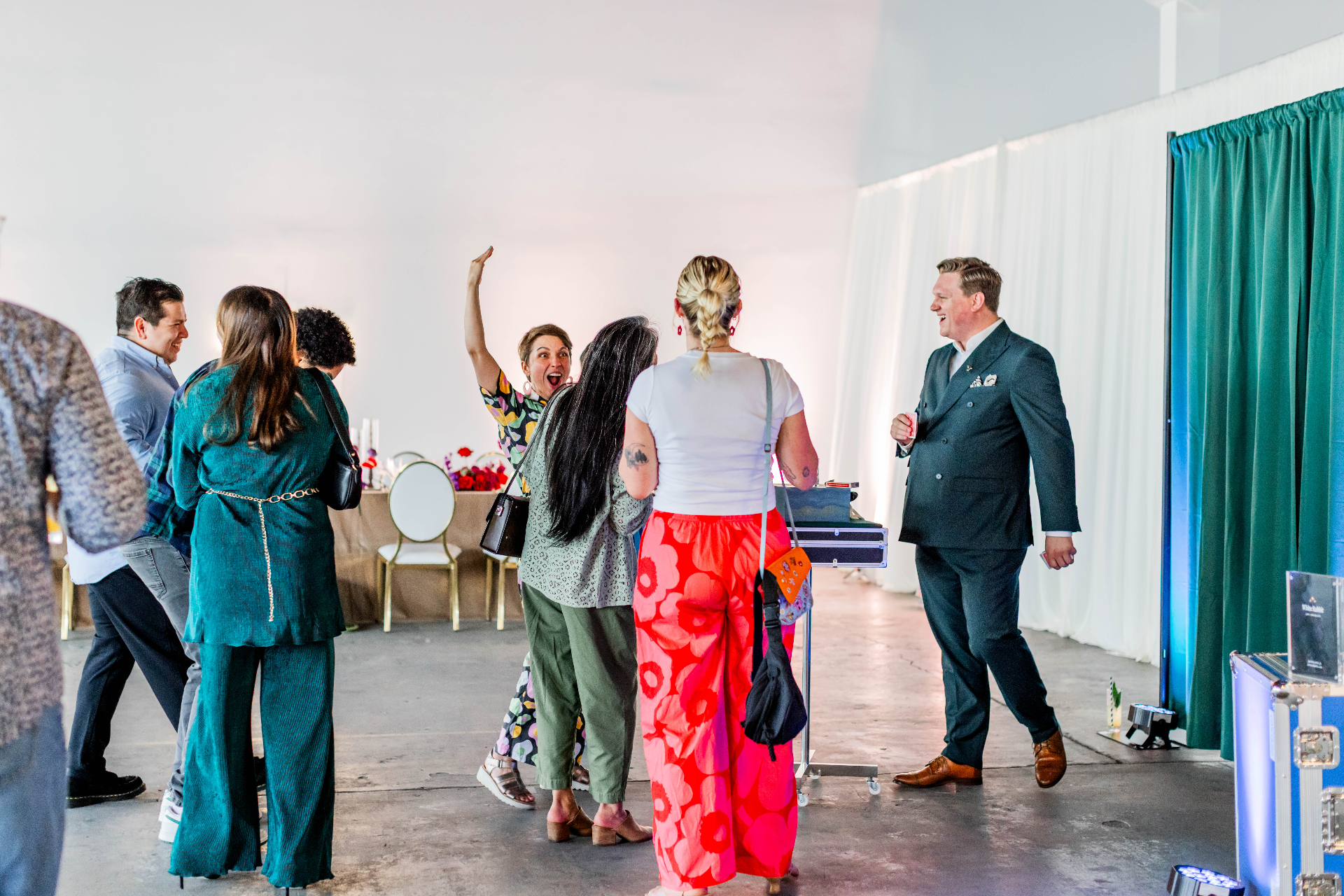
Here's what happens when I work a gala cocktail hour. I approach a table of eight people who are sitting with their drinks, maybe two conversations happening, the rest of the table quiet. I do something with a ring and a deck of cards that's visually impossible. The whole table leans in. The quiet people are suddenly talking. Someone calls over a friend from another table to come watch.
Within five minutes, that table has gone from polite silence to genuine energy. People are laughing, they're asking each other "did you see that," they're talking. When I move to the next table, the first table keeps that energy. They're connected now in a way they weren't ten minutes ago.
Multiply this across 20 or 30 tables during a 90-minute cocktail hour, and the room feels completely different by the time dinner starts. People are warmer.
Multiply this across 20 or 30 tables during a 90-minute cocktail hour, and the room feels completely different by the time dinner starts. People are warmer. They're more relaxed. They've had a shared experience that has nothing to do with the cause but everything to do with putting them in a generous headspace.
When the auctioneer steps up or the executive director makes the paddle raise appeal, the room responds differently than it would have if everyone had spent cocktail hour standing around.
I'm not saying magic makes people donate. I'm saying that people who are having a genuinely good time, who feel connected to the people around them, who are in an elevated emotional state, give more freely than people who've been bored. Gala organizers know this intuitively. That's why they care so much about the event experience. The entertainment choice during cocktail hour is the single biggest lever you have for getting the room right before the money part.
Insider Access
Enjoying this? There's more where it came from.
Get behind-the-scenes stories, event planning insights, and first access to upcoming shows. No spam, just magic.
No spam. Unsubscribe anytime.
The dinner entertainment gap
Most galas have a gap between dinner being served and the program starting. Fifteen to twenty minutes where people are eating, the room is settling in, and nobody's quite sure what they should be paying attention to. This is dead time, and it drains energy.
Close-up magic fills this gap perfectly. I'll work tables during dinner, doing intimate effects for groups of eight or ten while they eat. It keeps the room alive. People at nearby tables see something happening and they're curious, watching, waiting for their turn. By the time the program starts, the energy hasn't dropped. It's actually been building.
Compare this to a band playing during dinner. People talk over the music. The music competes with conversation. Some guests enjoy it, some find it annoying. It doesn't add energy to the room. It adds volume.
The budget reality for nonprofits
I understand that nonprofit event budgets are scrutinized more heavily than corporate ones. Every dollar spent on the gala is a dollar that didn't go directly to the mission. Your board cares about the cost-to-raise ratio, and your event committee is trying to balance "make it great" with "keep costs reasonable."
Here's how I think about it: if the entertainment during cocktail hour increases the energy in the room by even 10%, and that translates to even a modest increase in donations during the paddle raise, the entertainment has more than paid for itself. At a gala where you're raising $200,000, a 5% bump in donations is $10,000. The cost of a magician for the evening is a fraction of that.
I've had gala organizers tell me after the event that their paddle raise exceeded projections and that the room felt different from previous years. I can't take all the credit for that. The cause matters, the appeal matters, the ask matters. But the room's energy during the first 90 minutes matters too, and that's where the entertainment choice has real impact.
What gala organizers should think about
If you're on a gala committee or planning a fundraiser, think about what your guests actually experience in the first hour. Not what's on the printed program. What are they doing? Who are they talking to? Are they engaged or are they waiting for the evening to get going?
If the answer is "they're mostly standing around," your entertainment isn't doing its job. It doesn't matter how good the band is later. The tone gets set early.
Close-up magic during cocktail hour and dinner is the most reliable way I've seen to shift that early-evening energy. It doesn't require a stage, it doesn't need sound, it works in any venue, and it creates the kind of personal, memorable interaction that puts people in the right frame of mind before you ask them to open their wallets.
If you're planning a gala or fundraiser and want to talk about whether this would work for your event, reach out. I work with nonprofits, hospitals, schools, and foundations regularly. You can also check out my page for event professionals or take the quiz to see what format fits.
Ready to Elevate Your Next Event?
Tell us about your event and we'll usually confirm availability within a few hours.
35-Second Quiz
Not Sure What You Need? Take the Quiz
Take our quick quiz and discover your Magic Guest Persona, plus get a personalized, downloadable card to share.
No commitment, just a fun reveal and a tailored recommendation.
Take the QuizWhere We Perform
Luxury Event Entertainment Nationwide
Continue Reading
Corporate Events · 8 min read
Scottsdale Corporate Event Magician: Desert Luxury Meets World-Class Entertainment
Scottsdale's resort corridor hosts some of the most ambitious corporate events in the country. The entertainment should match the setting, and the stakes.
Corporate Events · 8 min read
Chicago Corporate Event Magician: Making the Midwest's Biggest Events Unforgettable
Chicago doesn't do anything small. The city's corporate events reflect the same ambition, substance, and no-nonsense sophistication that built the skyline. The entertainment should meet that standard.
Corporate Events · 8 min read
Boston Corporate Event Magician: Bringing World-Class Magic to New England's Most Prestigious Events
From Back Bay boardrooms to Harbor Hotel galas, Boston's corporate elite are discovering the entertainment that turns buttoned-up events into unforgettable experiences.
© 2026 White Rabbit Los Angeles. All rights reserved. No part of this publication may be reproduced, distributed, or transmitted in any form or by any means without the prior written permission of the publisher. All trademarks, service marks, and trade names referenced herein are the property of their respective owners.